Last Updated: March 2026
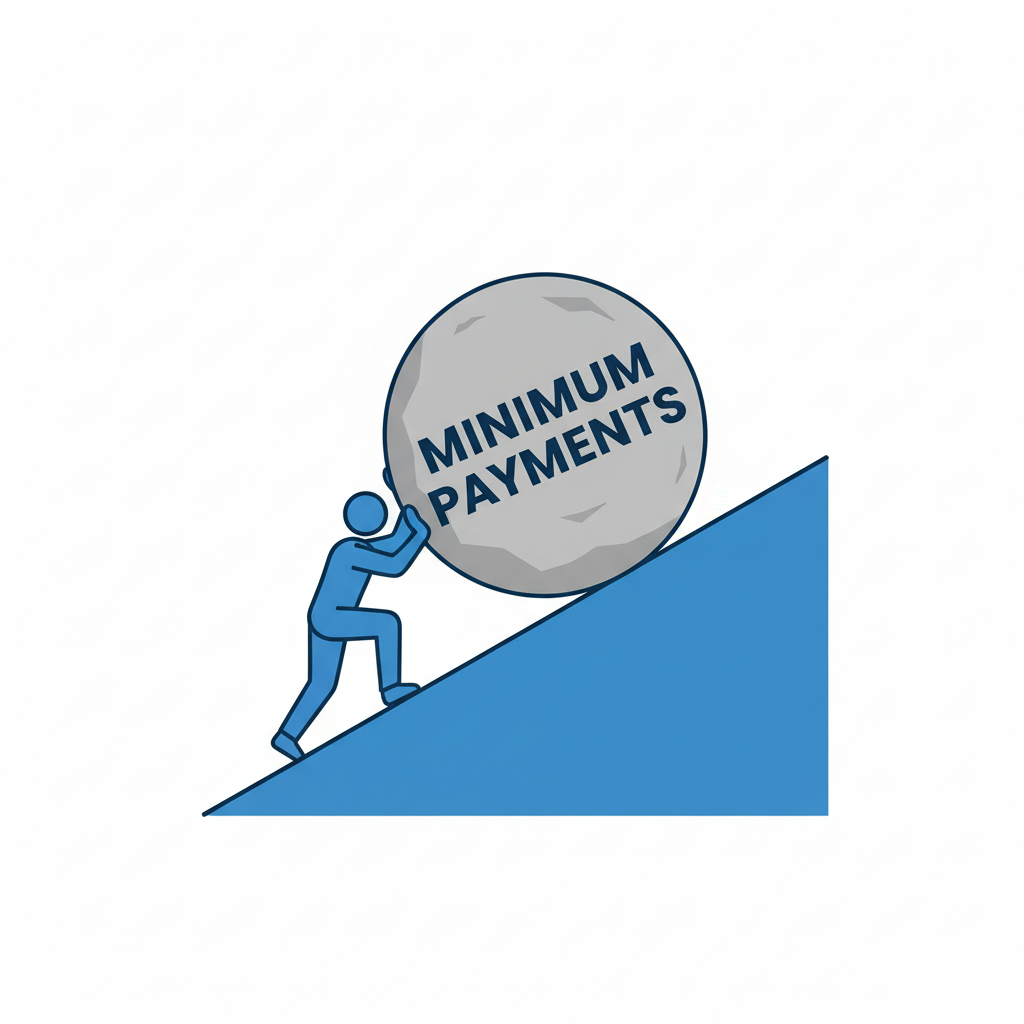
You make payments every month. The balance barely moves. A year goes by and the number on the statement looks almost identical to where it started — sometimes higher. This isn’t bad luck or a personal failure. It’s the predictable result of how credit card debt is specifically structured. Several forces are working against you at once, and understanding each one is the first step to actually getting out.
The Interest Rate Is Designed to Win
The average credit card APR as of mid-2025 was around 22–23% — the highest it’s been in decades. At that rate, every $1,000 you carry generates roughly $18–19 in interest every single month. That interest compounds daily, meaning it’s added to your balance and then earns interest itself.
The result: if you make only the minimum payment each month and never charge another dollar, you’re often barely keeping pace with the interest — and sometimes falling behind it.
Typical minimum payment (2% of balance): ~$132
Amount actually reducing the principal: ~$6
At this pace: 22+ years to pay off, $18,500+ in interest
That’s not a math error. That’s the minimum payment system working exactly as intended. The payment is calculated to be just barely above the interest charge — which keeps you current on the account while ensuring you carry the balance (and pay interest on it) for as long as possible.
Credit Cards Are Open — You Can Always Add More
A mortgage or auto loan has a fixed amount. Once borrowed, that number only goes down as you pay. Credit cards work differently: the credit line stays open, and new purchases can be added at any time. This creates a fundamental structural problem that most other debt doesn’t have.
Even if you’re making disciplined payments each month, a single unexpected expense — a car repair, a medical bill, a flight home for an emergency — gets charged to the card and adds to the balance you’re trying to reduce. You take one step forward, something happens, and you take one step back. Over months, the balance doesn’t move.
Unlike a personal loan (where you get the money, make fixed payments, and the balance always goes down), the open revolving structure of credit cards means the debt can grow at the same time you’re trying to shrink it.
The Minimum Payment Is a Psychological Trap
Credit card statements display the minimum payment prominently. It’s a small, manageable-looking number that your brain registers as “the right amount to pay.” When you pay it, your brain releases a small reward signal — you fulfilled an obligation, avoided a penalty, checked the box. You feel responsible.
But that feeling is disconnected from the financial reality. A 2025 Experian survey found that 2 in 5 Americans in credit card debt believe making the minimum payment is enough to manage it. It isn’t. The minimum is designed to keep the account current — not to reduce the debt.
Behavioral researchers call this “present bias” — the tendency to favor immediate relief (keeping $65 in your pocket today) over future benefit (paying less in total interest over time). Credit card issuers understand this thoroughly. The minimum payment isn’t a helpful suggestion. It’s a carefully designed number that maximizes how long you’ll carry the balance.
Variable Rates Move Against You When the Economy Shifts
Most credit cards have variable APRs tied to the federal prime rate. When the Federal Reserve raises interest rates — as it did repeatedly from 2022 through 2023 — every variable-rate credit card’s APR goes up automatically, often within one billing cycle. You didn’t do anything differently. Your rate just increased.
The average credit card APR jumped from around 14.6% in 2021 to over 22% by 2025 — an increase of nearly 8 percentage points. On a $5,000 balance, that’s the difference between $61 and $92 in monthly interest. For people already stretched thin making minimum payments, that extra $30/month can mean the balance actually starts growing instead of shrinking.
Unlike a mortgage or car loan with a fixed rate, credit card debt has no protection against rate increases. You carry the full risk of market rate movements on the highest-rate debt most people hold.
Life Keeps Happening While You’re Trying to Pay It Down
A Bankrate 2026 report found that 41% of credit card debtors say the primary cause of their debt was an emergency expense. That tracks with how most people end up in credit card debt in the first place — not reckless spending, but using the card as the financial backstop when income fell short or something unexpected happened.
The problem is that the emergency that created the debt rarely goes away cleanly. Medical costs continue. Groceries cost more. The car needs another repair. For many households, the card isn’t just a debt to pay off — it’s also the current emergency fund. New charges keep appearing on the same card you’re trying to pay down, and the balance never gets the uninterrupted run-down it needs.
This isn’t a discipline problem. It’s a structural one: without a separate emergency fund, the credit card is forced to serve two roles simultaneously — both the debt to eliminate and the safety net for the next problem.
What Actually Works
Understanding the forces working against you points directly toward what breaks them:
- Pay a fixed amount above the minimum — and hold it there. Don’t let your payment shrink as your balance does. Keeping your payment fixed accelerates paydown and defeats the shrinking minimum trap.
- Stop the balance from growing while you’re paying it down. This is the hardest part for most people. A 0% balance transfer card, if you qualify, stops new interest from accruing during the payoff window — every payment reduces principal directly.
- Build a small cash buffer before aggressively paying down the card. Even $500–$1,000 in a savings account means the next small emergency doesn’t immediately land back on the card you’re trying to pay off.
- Use the avalanche method on multiple cards. Direct extra payments to the highest-rate card first. The card that compounds fastest is the most urgent — not the one with the largest balance.
📋 Why Credit Card Debt Is Hard to Pay Off — Key Points
- Average APR is ~22–23%, generating $18–19/month in interest per $1,000 carried
- Minimum payments are calculated to barely exceed the monthly interest charge
- On a $6,600 balance at 23%: minimum payments = 22+ years and $18,500 in interest
- Variable rates rise with market conditions — you carry all the rate risk
- Revolving credit means new charges can add to the balance you’re paying down
- The minimum payment shrinks as the balance shrinks — extending the payoff timeline
- Solution: fixed payments above the minimum, stop adding charges, build a cash buffer
🧮 See How Long Your Debt Will Actually Take to Pay Off
Enter your balance and APR to find out your real payoff date — and how much faster you’d get there by paying more than the minimum.
Frequently Asked Questions
Q: Why does credit card debt feel impossible to pay off?
A: Because minimum payments are designed to keep your balance growing. At 21% APR, a large portion of every payment goes to interest rather than principal. The balance barely moves until you pay significantly above the minimum.
Q: How do people get trapped in credit card debt?
A: Usually through a combination of high interest rates, minimum payment habits, and unexpected expenses that keep adding to the balance. It’s not typically about overspending — Bankrate data shows 41% of credit card debt comes from emergencies.
Q: What is the most effective way to break the credit card debt cycle?
A: Stop adding new charges to cards you’re paying down, pay more than the minimum every month, and consider reducing the interest rate through a balance transfer or rate negotiation. Even an extra $50–$100/month makes a significant difference over time.
Financial Disclaimer: The content on this page is for informational and educational purposes only. It does not constitute financial, legal, or credit advice. DebtToolbox is not a financial advisor. Always consult a qualified financial professional before making decisions about your debt or finances.