Find out what happens when you only pay the minimum payment on a credit card and how much it really costs you.
Last Updated: March 2026
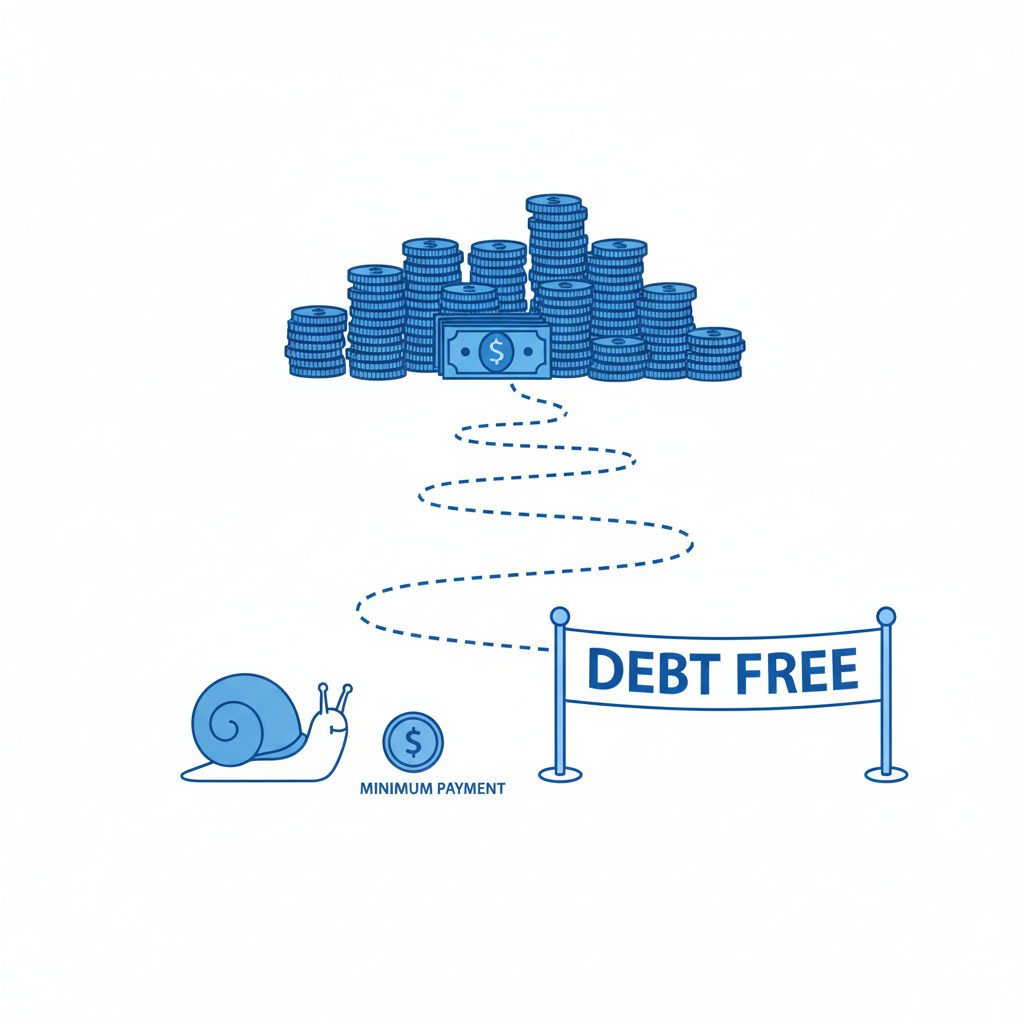
Every month, tens of millions of Americans make only the minimum payment on their credit cards and feel like they’re doing the right thing — staying current, avoiding late fees, keeping their account in good standing. And technically, they are. But minimum payments are designed to keep you in debt, not to help you get out of it. The math behind them is quietly brutal, and understanding it is one of the most important things you can do for your financial health.
What Is a Minimum Payment and How Is It Calculated?
Your minimum payment is the smallest amount you can pay each billing cycle to keep your account in good standing and avoid late fees. Pay it on time and you won’t be penalized — but that’s essentially all it does.
Most card issuers calculate the minimum as whichever is greater: a flat dollar amount (typically $25–$40) or a percentage of the outstanding balance (usually 1–2%), plus any fees and accrued interest. For smaller balances you’ll hit the flat minimum; for larger balances, the percentage method takes over.
On a $5,000 balance at a 2% minimum, you’d owe $100 per month. That sounds manageable — until you realize that at 24% APR, roughly $100 of interest is also accruing every month. You could be paying $100 and watching your balance barely move at all.
What Minimum Payments Actually Cost You Over Time
The damage from minimum payments isn’t obvious month to month — it accumulates slowly, the same way credit card interest does. Here’s what the math looks like at different balance levels, assuming a 22% APR and a 2% minimum payment:
| Balance | Monthly Minimum | Years to Pay Off | Total Interest Paid |
|---|---|---|---|
| $3,000 | ~$60 | ~14 years | ~$3,800 |
| $5,000 | ~$100 | ~23 years | ~$7,500 |
| $10,000 | ~$200 | ~11+ years | ~$17,000 |
That last number deserves a moment. A $10,000 debt, minimum payments only, ends up costing you $27,000 total — $17,000 of which is pure interest. You’d pay almost twice the original balance just for the privilege of taking 11 years to eliminate it.
Minimum Payments Are Designed to Maximize Interest
This isn’t an accident. Minimum payments are structured the way they are because it benefits card issuers — not cardholders. When you pay only the minimum, the bulk of your payment goes toward interest and fees, with barely anything touching the actual principal.
Credit card interest compounds daily. Every day, your remaining balance accrues a small amount of interest (your APR divided by 365). The next day, interest is calculated on that slightly larger amount. This daily compounding means that even a few days of delay in paying costs you more than you’d expect.
A 2025 study by the Federal Reserve Bank of Philadelphia found that over 65 million credit card accounts — roughly 1 in 9 active accounts — were receiving only the minimum payment each month. That’s the highest rate since 2012, and it signals that a significant portion of American cardholders are trapped in exactly this cycle.
What Paying the Minimum Does — and Doesn’t — Do for You
There are a few legitimate benefits to making the minimum payment when that’s all you can manage:
- Keeps your account in good standing. No late fee, no penalty APR, no collections risk.
- Protects your credit score. Payment history is 35% of your FICO score. On-time minimum payments still count as on-time payments.
- Prevents the worst outcomes. Missing a payment entirely can drop your score by 60–100 points and stay on your report for 7 years. Paying the minimum avoids all of that.
What minimum payments don’t do: reduce your balance meaningfully, lower your interest costs, or get you closer to financial freedom. At high APRs, minimum payments can keep a balance essentially flat for months at a time — you’re paying, but barely moving.
How to Pay More Than the Minimum — Even a Little Helps
You don’t need to pay off your entire balance at once to dramatically change your outcome. Even modest increases above the minimum make a major difference thanks to how compound interest works in reverse when you’re paying it down.
On a $10,000 balance at 22% APR with a 2% minimum payment: paying just $200/month (doubling the minimum) cuts payoff time from 11+ years to roughly 3 years and reduces total interest from $17,000 to about $3,700. That’s a $13,000 difference for $100 more per month.
Here are practical ways to find that extra money:
- Audit your subscriptions. Most people find $20–$60 worth of services they no longer use or need.
- Apply windfalls directly to your balance. Tax refunds, bonuses, gifts — all of these can make a dent that changes your payoff timeline dramatically.
- Consider a balance transfer. Moving your balance to a 0% APR card means every dollar you pay goes directly toward reducing principal. Even paying the same amount per month, you’d pay it off years faster.
- Use the debt avalanche or snowball method. Once you’ve paid off one card, roll those payments into the next. Momentum builds quickly.
📋 Key Takeaways
- Minimum payments keep your account current — but barely reduce your balance
- At 22% APR, a $10,000 balance costs ~$17,000 in interest on minimums alone
- Credit card interest compounds daily — even small delays cost more than expected
- Over 65 million U.S. accounts pay only the minimum — don’t be one of them long-term
- Doubling your payment can cut total interest by 70–80% and save years of debt
- Balance transfers, avalanche/snowball methods, and windfalls all help break the cycle
🧮 Find Out What Your Minimum Payments Are Really Costing You
Enter your balance, rate, and payment amount to see the full picture.
Frequently Asked Questions
Q: What happens if I only make minimum payments on my credit card?
A: Your balance decreases very slowly because most of the payment goes to interest. A $5,000 balance at 21% APR paid with minimums only could take nearly 5 years and cost over $3,000 in interest.
Q: How are minimum payments calculated?
A: Most issuers calculate the minimum as either a flat amount (like $25–$35) or a percentage of your balance plus interest — whichever is greater. This is typically 1–2% of your total balance.
Q: Is it bad to pay just the minimum on a credit card?
A: It keeps your account in good standing and avoids late fees, but it’s costly long-term. You’ll pay far more in total interest and take much longer to become debt-free. Always pay more than the minimum when possible.
Financial Disclaimer: The content on this page is for informational and educational purposes only. It does not constitute financial, legal, or credit advice. DebtToolbox is not a financial advisor. Always consult a qualified financial professional before making decisions about your debt or finances.