
Last Updated: March 2026
A single missed payment is the most damaging thing that can happen to a credit score in a short period of time. More than high utilization, more than a hard inquiry, more than closing an old account — a late payment reported to the credit bureaus can drop a score by 60 to 110 points almost overnight. If you’ve just missed one, or you’re worried about missing one, here’s exactly what happens and what you can do about it.
Your Score Doesn’t Drop Immediately — But the Clock Starts
Missing a due date doesn’t instantly appear on your credit report. Most lenders don’t report a late payment to the credit bureaus until the account is at least 30 days past due. That means if you missed a payment yesterday, you likely have a window to catch up before any credit damage occurs.
What does happen immediately when you miss a payment:
- A late fee is charged — typically $25–$40, or up to the CFPB’s limit for the billing cycle
- Your card issuer may apply a penalty APR to new purchases and possibly existing balances — sometimes as high as 29.99%
- Interest continues compounding on the unpaid balance
If you catch it within 30 days, pay immediately. You’ll still owe the late fee and potentially a higher rate, but your credit score will be completely unaffected.
What Happens at 30, 60, 90 Days — and Beyond
30 Days Late — First Credit Bureau Report
Your lender reports the missed payment to Equifax, Experian, and TransUnion. Your credit score drops. Depending on your starting score, the drop can range from 60 to 110+ points. This derogatory mark stays on your report for 7 years from the date of the original missed payment.
60 Days Late — Second Report, More Damage
If still unpaid at 60 days, a second derogatory mark is reported. Your score drops further. Penalty interest rates (if applied) are now in full effect on the balance. Lenders monitoring your account may lower your credit limit or flag the account.
90 Days Late — “Seriously Delinquent” Status
At 90 days, the account is classified as seriously delinquent. A 2025 Federal Reserve analysis found that 90-day delinquency can knock more than 170 points off the score of a borrower who started above 760. The account may be referred to a debt collections department internally.
120–180 Days — Charge-Off and Collections
After 120–180 days without payment, most card issuers charge off the account — declaring the debt a loss and often selling it to a third-party collection agency. A charge-off and a subsequent collections account are two separate negative items, both of which remain on the report for 7 years.
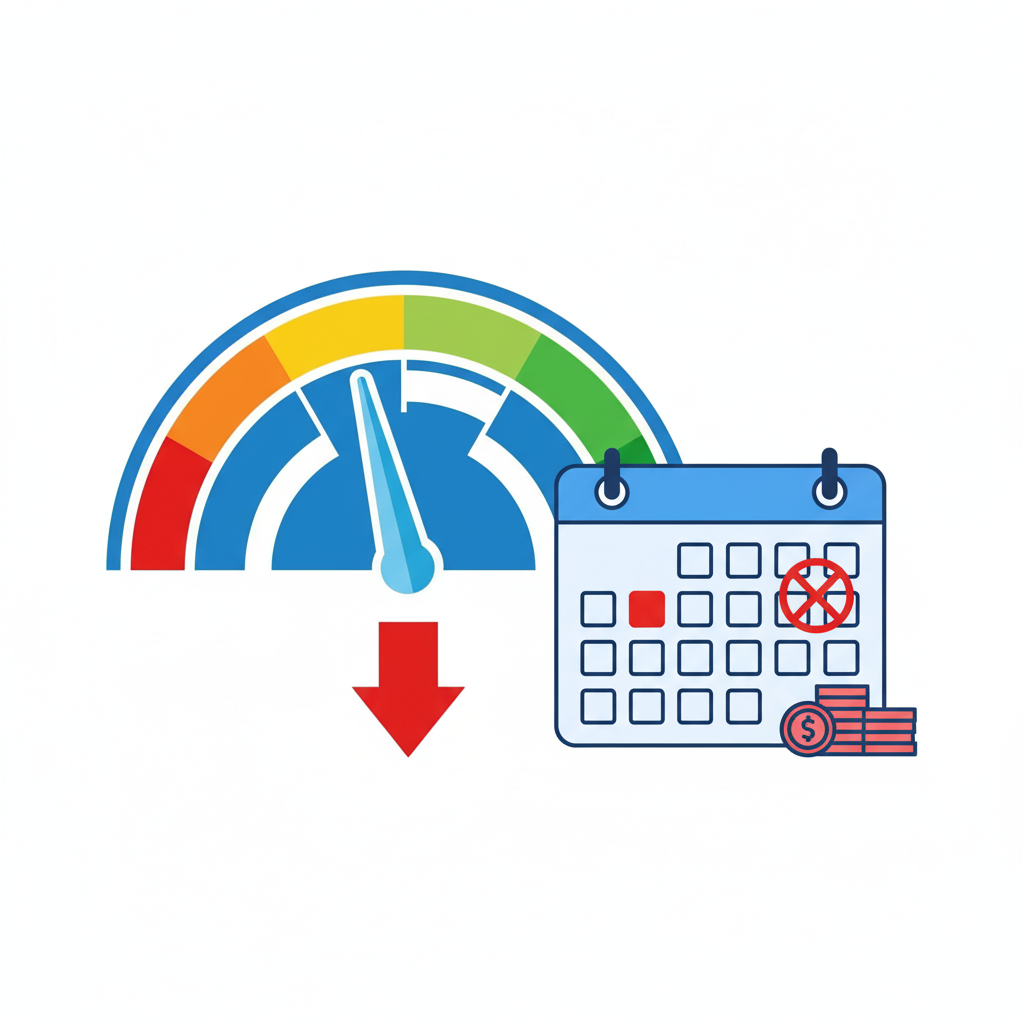
The Higher Your Score, the Harder the Fall
One of the most counterintuitive things about credit scoring is that a missed payment hits people with excellent credit harder than those with poor credit. This is because the scoring models are measuring risk relative to your history. For someone who has always paid on time, a single missed payment is a dramatic departure from established behavior — and the model treats it that way.
A 90-day delinquency can drop a score above 760 by 171 points on average, per Federal Reserve data. Even a 30-day late can cost 90–110 points.
Still severe. A score of 760 could drop to 650 — moving from “Very Good” to “Fair” territory, with real consequences on rates and approvals.
A drop here moves you into subprime territory, below the 620–670 threshold where many conventional loan options close off.
Smaller drop in absolute terms, because the model already reflects higher risk. But adding another negative mark makes recovery harder and longer.
How to Recover After a Missed Payment
The damage is real, but it’s not permanent. Credit scores are forward-looking — every month of on-time payments after a missed one starts rebuilding the picture. Here’s how to recover as efficiently as possible:
- Pay the overdue amount immediately. The sooner you pay and bring the account current, the sooner the clock on recovery starts. A paid late payment is still a negative mark, but it stops accumulating additional damage.
- Don’t miss any future payments. A single missed payment followed by consistent on-time payments recovers faster than a pattern of occasional late payments. Every clean month chips away at the impact of the original delinquency.
- Call and ask for a goodwill adjustment. If you’ve been a long-standing customer with an otherwise clean history, some lenders will remove or suppress a first-time late payment from their report — particularly if it was an honest mistake (like a banking error or a skipped autopay). This isn’t guaranteed, but it’s worth asking. A goodwill letter sent to the issuer’s customer service or executive team often works better than a phone call.
- Check if the penalty APR can be reversed. Under the CARD Act, if you make 6 consecutive on-time minimum payments after a penalty rate was applied, the issuer is generally required to reinstate your previous rate.
- Keep utilization low. While waiting for the payment history to recover, keeping credit utilization under 30% helps the other major scoring factor stay positive and partially offsets the damage.
The Simplest Ways to Never Miss a Payment
Payment history is 35% of a FICO score — the single largest factor. Protecting it is the highest-return habit in personal finance. Fortunately, it’s also the easiest to automate:
- Set up autopay for at least the minimum. Even if you can’t always pay in full, automating the minimum payment guarantees you’ll never trigger a 30-day late, regardless of what else is going on in your life.
- Set calendar or phone reminders 5–7 days before due dates. This gives you a buffer to move money or catch a shortfall before the deadline.
- Align due dates with your pay schedule. Most card issuers will change your due date to a different day of the month on request. If all your bills come due a few days after each paycheck lands, the timing risk disappears.
- Simplify the number of accounts. The more accounts you have, the more due dates you’re tracking. Consolidating debt where possible — either through a balance transfer or personal loan — reduces the surface area for missed payments.
📋 Missed Payments and Your Credit Score — Key Points
- Payments under 30 days late are NOT reported to credit bureaus — act fast if you’ve just missed
- At 30 days: a single late payment can drop scores by 60–110 points depending on your starting score
- At 90 days: “seriously delinquent” status — 170-point drops possible for borrowers above 760
- Higher scores take bigger hits — the model penalizes departure from established behavior
- Late payments stay on your report for 7 years, but their impact weakens over time
- Recovery = pay immediately, then maintain clean history; consider requesting goodwill removal
- Autopay for the minimum is the simplest protection against accidental late payments
🧮 Protect Your Score by Getting on Top of Your Debt
The best protection against missed payments is a manageable payoff plan. See how long it will take to clear your balance — and what it costs to carry it.
Frequently Asked Questions
Q: How long does a missed payment stay on your credit report?
A: A late payment (30+ days past due) stays on your credit report for seven years from the date of the missed payment. However, its impact on your credit score decreases over time as you build positive payment history.
Q: Will one missed credit card payment ruin my credit?
A: A single missed payment can drop your score significantly — potentially 50–80 points depending on your current score. However, it’s recoverable. Consistent on-time payments after that point will gradually rebuild your score.
Q: What should I do if I miss a credit card payment?
A: Pay it immediately — even a few days late is better than 30 days late, which is when it gets reported to credit bureaus. Call your issuer and ask for a goodwill adjustment to remove the late mark if you have a clean history otherwise.
Related Resources
→ How to Improve Your Credit Score
→ What Is a Good Credit Score
Financial Disclaimer: The content on this page is for informational and educational purposes only. It does not constitute financial, legal, or credit advice. DebtToolbox is not a financial advisor. Always consult a qualified financial professional before making decisions about your debt or finances.